Call Today for Your FREE Consultation
630-355-7776
650 Diehl Road, Suite 117, Naperville, IL 60563


- Home
- Attorneys
- Practice Areas
- Testimonials
- Articles
- Stages of Divorce
- 10 Tips for Surviving Divorce
- Why Divorce Litigation is Sometimes Necessary
- What You Need to Know About Spousal Maintenance
- Trend toward “gender reversal” in marriage affects divorce
- Increase in boomer divorces and the issues faced by older couples
- Questions You Should Ask Your Prospective Divorce Attorney
- Working With Your Spouse to Divide Marital Debt
- Blog
- Contact Us
Understanding the Asset Division Process in Illinois Divorces
 For many couples, asset division is one of the most contentious issues that they will work through when they get divorced. Both spouses usually feel entitled to marital property. Both spouses are almost always worried about their current and future financial stability.
The truth is, the outcome of dividing your property and debt in divorce has the potential to impact your life for years, if not decades. If you are going through a divorce in Illinois in 2026, it is important that you understand how the asset division process works.
Our DuPage County divorce attorneys are here to help. We have over 30 years of experience with divorce in Illinois and will fight for you to get a favorable asset settlement.
Is Illinois an Equitable Distribution State?
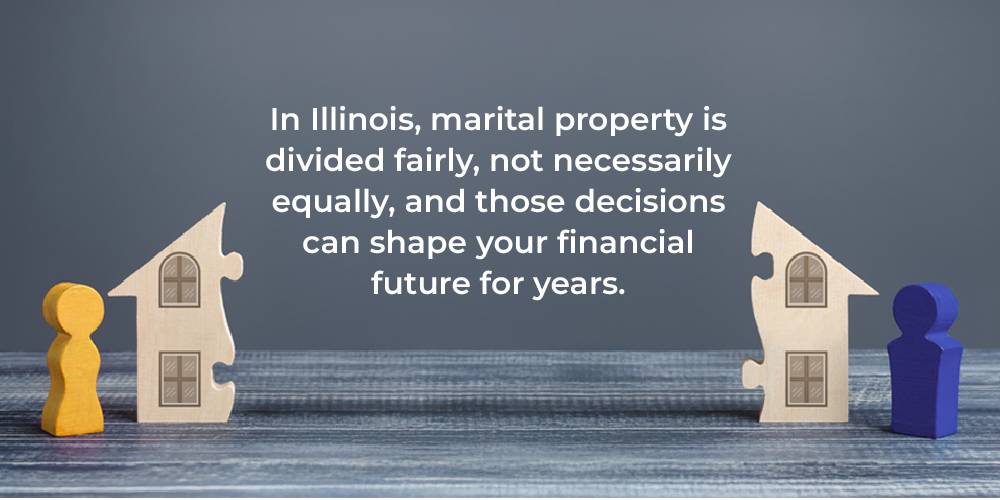
Each state across the country has different divorce laws. Some states are considered "community property" states, which means they generally split all assets 50/50. Illinois is not one of those states and is instead an "equitable distribution" state. This means that marital assets and debt will not always be split equally. Instead, the goal is to make sure they are divided fairly.
Couples are almost always able to divide their property on their own, with the help of a mediator if necessary. When courts have to get involved, the goal is to figure out what property settlement would be the most fair.
What Makes Property Marital Vs. Separate?
According to the Illinois Marriage and Dissolution of Marriage Act under 750 ILCS 5/503, there is a difference between marital and nonmarital property. Only marital property is subject to division upon divorce.
What is Marital Property?
Marital property includes almost any type of property that was acquired by either spouse after the marriage and before the divorce. This includes:
-
Income
-
Real estate
-
Savings
-
Cryptocurrency
-
Intellectual property
What is Non-Marital Property?
Non-marital or separate property includes assets one spouse owned before the marriage. Inheritances and gifts that are given to one spouse only are also separate property. However, separate property can become marital property.
How Does Separate Property Become Commingled?
Separate property does not always stay separate. "Commingling" happens when you mix non-marital assets with marital assets in a way that makes them difficult to separate as marital vs. non-marital.
For example, if you deposit inherited money into a joint bank account that both you and your spouse use for household expenses, that non-marital inheritance can become marital property. The same can happen if you use premarital savings to pay down a joint mortgage. Once assets are commingled, the court may treat them as marital property subject to division.
What Are Common Types of Premarital Assets and Their Legal Status?
Different types of premarital assets present different challenges during divorce.
-
Retirement accounts owned before marriage are generally considered separate property, but contributions made during the marriage are marital property.
-
Businesses started before marriage can be complicated because the increase in value during the marriage may be considered marital property.
-
Real estate owned before marriage typically remains separate unless marital funds were used for mortgage payments, improvements, or upkeep.
-
Savings accounts are separate if kept in one spouse's name and not mixed with marital funds.
-
Premarital debt usually stays with the spouse who borrowed it. Debt taken on during the marriage is typically divided between spouses.
Do Debts Get Divided in an Illinois Divorce?
Another big issue that people forget about during the asset division process is that they must also divide all of the debt that they have borrowed with their spouse. Just like asset division, debt is divided in an equitable manner based on a variety of factors.
For example, consider this scenario: A couple has a car loan that needs to be divided. One spouse is a homemaker and the other spouse is employed. The employed spouse’s name is on the car loan, but the couple took out the loan during the marriage, making the debt belong to both spouses.
The car may end up with the employed spouse, who will be responsible for making payments. But the car might also end up with the homemaker spouse and count as part of the employed spouse’s alimony payments.
Again, couples are strongly encouraged to divide their property and debt in a way that makes sense for them. Leaving property division to a judge can result in a settlement nobody is happy with.
Can You Use Mediation for Property Division During Divorce?
Mediation allows couples to negotiate property division with the help of a neutral third party. This process is often faster, less expensive, and less stressful than going to court.
In mediation, you have more control over the outcome and can come up with creative solutions that a judge might not order. Mediation works best when you both are willing to communicate and compromise.
What Happens if We Cannot Divide Our Property Out of Court?
If you and your spouse cannot reach an agreement through negotiation or mediation, the court will decide for you. A judge will review all important factors before making a decision. Even if your case seems destined for litigation, however, judges will often call pre-trial conferences after reviewing your case. In a pre-trial conference, the judge can tell you what the most likely outcome will be – and encourage you to settle, rather than moving forward with litigation.
If this still doesn’t succeed, the court will hear the full case and then issue a ruling that divides your property equitably. Litigation takes longer and costs more, but it may be necessary when one spouse is uncooperative or there are factual disagreements about assets.
Contact a DuPage County Divorce Lawyer Today
At Law Office of Ronald L. Hendrix, P.C., we believe in the effectiveness of mediation, but we will still fight for our clients’ property rights when necessary. Our head Naperville asset division attorney has been practicing family law since 1985 and has helped clients settle property issues through collaborative law, mediation, and litigation. To schedule a consultation, call our office today at 630-355-7776.










650 Diehl Road, Suite 117, Naperville, IL 60563


Contact Our Firm
 The use of the Internet or this form for communication with the firm or any individual member of the firm does not establish an attorney-client relationship. Confidential or time-sensitive information should not be sent through this form.
I have read and understand the Disclaimer and Privacy Policy.