Call Today for Your FREE Consultation
630-355-7776
650 Diehl Road, Suite 117, Naperville, IL 60563


- Home
- Attorneys
- Practice Areas
- Testimonials
- Articles
- Stages of Divorce
- 10 Tips for Surviving Divorce
- Why Divorce Litigation is Sometimes Necessary
- What You Need to Know About Spousal Maintenance
- Trend toward “gender reversal” in marriage affects divorce
- Increase in boomer divorces and the issues faced by older couples
- Questions You Should Ask Your Prospective Divorce Attorney
- Working With Your Spouse to Divide Marital Debt
- Blog
- Contact Us
How Is Property Divided in an Illinois Divorce?
 Property division is often one of the hardest issues in divorce. When a marriage ends, spouses must determine who gets the house, the retirement accounts, the cars, and other assets. This can lead to friction when spouses disagree about how to portion out these assets. Understanding how Illinois courts handle property division will help you make smarter decisions during your divorce.
At Law Office of Ronald L. Hendrix, P.C., our Naperville, IL family law attorney can guide you through the complexities of asset division. Attorney Ronald Hendrix has over 30 years of legal experience, and across his career, he has helped many spouses through even the most difficult divorces.
How Does Equitable Distribution Work in an Illinois Divorce?
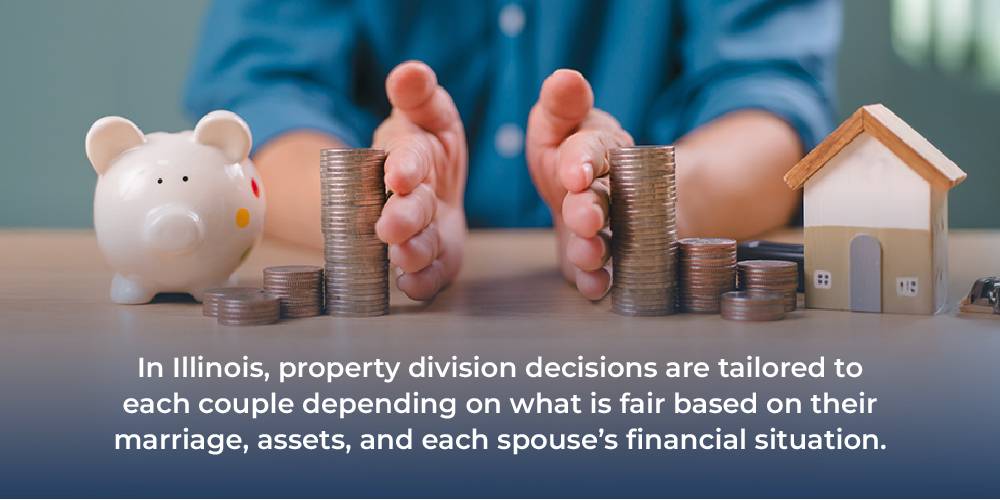
Illinois follows the principle of equitable distribution when it comes to dividing property in divorce. This means that when a court divides marital property, the goal is fairness rather than a strict 50-50 split. Couples are encouraged to come up with a property settlement on their own. When necessary, the court will do it for them.
What Property Can Be Divided in an Illinois Divorce?
In a divorce, Illinois courts treat assets as either "marital" or "separate," which greatly affects how property is divided. Marital property includes all assets and debts acquired by either spouse during the marriage. Marital property must be divided. Separate property includes assets owned by one spouse before the marriage or given to them specifically as a gift or inheritance. Separate property remains with the spouse who originally owned it.
What Factors Do Illinois Divorce Courts Consider When Dividing Property in 2026?
750 ILCS 5/503 lists several factors courts must consider when dividing marital property:
-
Contributions of each spouse to the marital or non-marital property
-
Whether either spouse wasted marital property
-
The value of the assets awarded to each spouse
-
The length of the marriage
-
The economic circumstances of both parties
-
Duties and rights from previous marriages
-
Existing prenups or postnups
-
Each spouse’s age, health, employability, income sources, and other needs
-
Custody arrangements
-
Whether or not spousal support was awarded
-
Each spouse’s potential to bring in more income and assets after the marriage
-
The tax implications of property division
Can a Prenup or Postnup Dictate Property Division?
A prenuptial or postnuptial agreement can play a major role in how property is divided in an Illinois divorce. These agreements allow spouses to decide in advance what happens to certain assets or debts if the marriage ends. That can include businesses, real estate, retirement accounts, or family inheritances.
Illinois courts generally enforce prenups and postnups if they meet legal requirements. Both spouses must have entered the agreement voluntarily. Each side must have made a fair financial disclosure. The terms also cannot be unconscionable at the time of enforcement. If those standards are met, the court will usually uphold the agreement. This can work in your favor if you want more control over how assets are divided, instead of leaving it to the court.
That said, these agreements are not always ironclad. A court may decline to enforce an agreement if there is evidence of fraud, coercion, or extreme unfairness. Still, when properly drafted, a prenup or postnup can reduce conflict and uncertainty during divorce.
How Are Retirement Accounts Divided in a Divorce?
Investments in retirement accounts are marital property if the money was earned during the marriage. A Qualified Domestic Relations Order (QDRO) is often required to divide employer-sponsored plans like 401(k)s or pensions without triggering early withdrawal penalties or taxes.
What Happens to the Family Home in a Divorce?
You have several options for handling your home in divorce. Most couples sell the home and divide the proceeds. Other couples have one spouse buy out the other's share. Sometimes one spouse will remain in the home for a period of time before selling.
If you cannot agree about what to do with your house, a judge will consider several factors before deciding for you. These include whether minor children live in the home, whether you can afford to keep the home alone, and each spouse's overall financial health.
Can Spouses Agree on Property Division Without Court Involvement?
Illinois encourages spouses to reach their own agreements on property division. If you and your spouse can agree on how to divide your property, you can submit a property settlement agreement to the court. A judge will typically approve your agreement as long as it appears fair and both parties entered into it voluntarily.
Handling Property Disagreements Through Mediation
When spouses disagree about property division, mediation can offer a practical path forward. Mediation allows both parties to negotiate with the help of a neutral third party instead of fighting in court. The process is private, flexible, and often far less expensive than litigation.
In property disputes, mediation gives spouses more control. They can craft solutions that fit their financial reality instead of relying on a judge who does not know their lives. Even high-conflict cases can benefit when both sides are willing to participate in good faith. According to the American Bar Association, mediation ends in agreement around 70 to 80 percent of the time, making it a sound choice in contested cases.
How Are Debts Split Up in a Divorce?
Debts have to be divided along with assets in a divorce. When deciding how to assign debts, Illinois courts look closely at when a debt was incurred and why it was taken on. Debts acquired during the marriage for marital purposes are often treated as shared obligations, even if only one spouse’s name appears on the account.
Common examples of shared debt include credit card balances, car loans, and certain tax liabilities. In contrast, debts tied to one spouse’s non-marital property may remain that spouse’s responsibility. Courts may also look at who actually benefited from the debt and which spouse is in a better position to pay it back when deciding how to divide responsibility.
Debt disputes can be stressful and expensive if not handled carefully. Many couples are able to limit long-term financial problems by working through debt division in mediation or settlement talks, where practical payment plans can be agreed on early.
Contact a Naperville, IL Divorce Attorney
Property division requires careful analysis of complex financial and legal issues. An experienced Will County, IL family law attorney at Law Office of Ronald L. Hendrix, P.C. can help you understand your rights. Call 630-355-7776 to schedule a consultation and discuss your case.










650 Diehl Road, Suite 117, Naperville, IL 60563


Contact Our Firm
 The use of the Internet or this form for communication with the firm or any individual member of the firm does not establish an attorney-client relationship. Confidential or time-sensitive information should not be sent through this form.
I have read and understand the Disclaimer and Privacy Policy.